-

Mobile phone: 13724352725
-

Email: liliangbin@szsyjm.com
-

Phone: 0755-22715304

Mobile phone: 13724352725
Email: liliangbin@szsyjm.com
Phone: 0755-22715304

 Current Location : Home > News
> Industry news
Current Location : Home > News
> Industry news
Due to the particularity of the working method, synchronous electric spindles generate a large amount of heat during rotation due to the built-in motor and rolling bearings. Let's take a look belowSynchronous electric spindleThe advantages and disadvantages of different cooling methods.
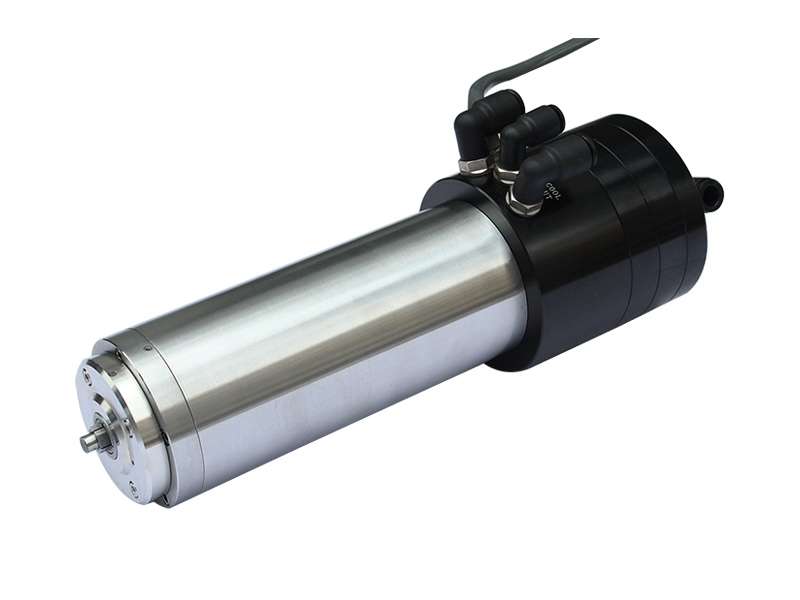
The synchronous electric spindle has a compact structure, small gaps, and weak spontaneous heat dissipation effect. Therefore, if it cannot dissipate heat in a timely manner, it will cause varying degrees of thermal expansion between the internal parts of the electric spindle, affecting the performance parameters such as stiffness and machining accuracy of the synchronous electric spindle, and seriously affecting the service life of the spindle.
Therefore, cooling methods are important for synchronous electric spindles. For the overall cooling of electric spindles, there are usually two methods: liquid cooling and air forced cooling. Liquid cooling deficiency refers to the design of circulating cooling water inside the electric spindle, with corresponding cooling machines on the outside.
In this way, the coolant can circulate inside the synchronous spindle, taking away internal heat. The advantages of this cooling method are simple and reliable design, and significant cooling effect. The disadvantage is that the cooling effect on the spindle core is poor, and the cost of the cooling machine is relatively high.
Air forced cooling refers to the design of a forced convection channel between the electric spindle housing and the motor stator. The heat generated by the motor enters the forced convection zone through thermal conduction, bringing the heat into the air and achieving constant temperature operation of the electric spindle.
Relatively speaking, the air forced cooling of synchronous electric spindles has the characteristic of no pollution. If a static pressure gas bearing is used, the gas in the static pressure gas bearing can be used to circulate inside the spindle, taking away some of the heat from the motor. In short, it is necessary to cool and dissipate heat from synchronous electric spindles, especially in high-temperature weather.
If the synchronous electric spindle is found to be overheated during use, it is necessary to consider whether heat dissipation measures should be taken to prevent the electric spindle from running in an overheated state, which may affect its service life. And it is necessary to choose a suitable cooling method, so as to achieve better cooling effect.
E-mail:liliangbin@szsyjm.com
Address:A2 Building,Second row,Baishixia west area,Fuyong Town, Baoan District, Shenzhen
 Home
Home Products
 Tel
Tel Map
Map